Estonia builds skateparks. Most of Europe doesn't.
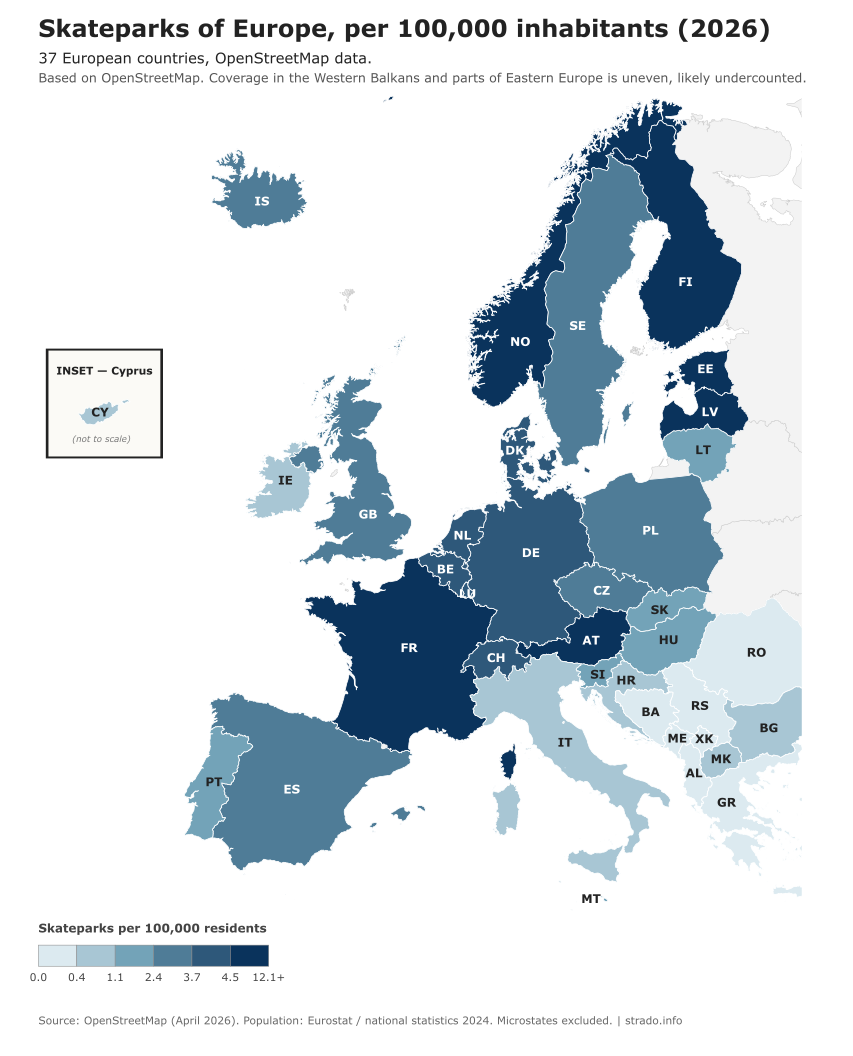
Estonia, a country with the population of Munich, has 166 skateparks tagged in OpenStreetMap. Twelve per 100,000 residents. The next-highest country in Europe is Austria at 6.5, and after that the curve drops. Six Western Balkan countries average below 0.2 parks per 100,000 between them. Montenegro has zero. The data covers 37 European countries plus the UK; Estonia leads it by a factor of two.
Skatepark density tracks public outdoor-recreation investment, not skating culture. Mediterranean countries with deep skating scenes (Spain, Italy, Greece) sit in the middle to the bottom of the per-capita ranking. Northern and Alpine countries with well-funded municipal recreation budgets sit at the top. France is the absolute leader with 3,978 parks but, divided across 68 million people, comes in fifth per capita. The pattern follows budgets.
Why Estonia
Two things explain it. First, Estonia has one of the most active OpenStreetMap mapping communities in Europe per capita; the country digitised its government services early, and the same volunteer culture spilled into infrastructure tagging. If a skatepark exists in Estonia, it's probably on the map. Second, outdoor recreation has been a Tallinn-and-rural budget priority through the 2010s. Tallinn alone has dozens of pads. Smaller municipalities each have one. Spot-checking the Estonian count against satellite imagery suggests it's mostly real, not a tagging artefact.
Why France looks moderate
France leads in absolute terms with 3,978 parks. Per capita that's 5.8, below Norway and Latvia. Skateboarding became an Olympic discipline at Tokyo 2020 and a permanent one at Paris 2024, and French municipal money has been flowing to the sport for two decades through the Fédération Française de Roller et Skateboard. The per-capita number says France is large, not exceptional. Germany follows the same pattern: 3,587 parks, 4.25 per capita. Big countries with consistent investment look like middle of the pack.
The Balkan floor
Montenegro: zero parks. Bosnia and Herzegovina: two. Kosovo: one. Albania: three. North Macedonia: eight. Serbia: nineteen. The whole Western Balkans group is below 0.5 per 100,000, and so is Greece (0.36) and Romania (0.38). Some of this is the OSM coverage gap. The mapping community in the region is smaller and less complete. Spot-checking Belgrade and Sarajevo against Google Maps suggests the real count is roughly 1.5 to 2 times what OSM shows. Even doubled, the deficit holds. Public investment in outdoor recreation has been thin in these countries since the 1990s, and the chart shows it.
Italy at 1.12 is the most surprising case in the dataset. A country with a real skating culture and a Mediterranean climate, ranked closer to Hungary than to its western neighbours. Public-park budgets have been tight in Italy for fifteen years, and OSM coverage outside the major cities also lags.
What the data doesn't see
The data sees parks tagged in OpenStreetMap. It doesn't see DIY spots, which is how skating actually works in countries without infrastructure money. It doesn't separate a 50-square-metre concrete pad from a 5,000-square-metre World Skate-rated bowl. It doesn't see use, quality, or whether the park has been swept this year. Skatepark infrastructure is expensive, and counting parks is the only variable available consistently across 37 countries. The geography would shift slightly with a tighter filter (only public-authority parks, only purpose-built ones). It wouldn't shift much.
If you live somewhere on the lower half of this map and know parks that aren't tagged on OpenStreetMap, add them. The map updates as the data does. The data isn't owned by anyone.